To determine whether an S Corporation (S Corp) or a Single-Member LLC (disregarded entity) is more tax-advantageous to a business owner with $100,000 net income, let’s compare both from a U.S. federal tax perspective (assuming the owner is a U.S. resident individual):
📌 Summary Table:
Factor
Single-Member LLC
S Corporation
Federal Tax Treatment
Disregarded entity – taxed as sole proprietorship on Schedule C
Pass-through entity – files Form 1120S, income reported on Schedule K-1
Self-Employment Tax
Applies to entire $100,000
Applies only to reasonable salary portion
Payroll Setup
Not required
Required for owner-employee
Reasonable Salary Required
❌ No
✅ Yes
Distributions (no SE tax)
❌ N/A
✅ After salary, remaining profits can be distributed without SE tax
Additional Admin Costs
Low
Higher (payroll, extra tax filings, compliance)
💰 Tax Impact Comparison (Assuming $100,000 Net Income)
🔹 Single-Member LLC (default)
Self-Employment Tax (15.3%) on full $100,000: → ≈ $15,300
Federal Income Tax (assumed 22% for illustration): → ≈ $22,000
Total Estimated Taxes: ≈ $37,300
🔹 S Corporation (assume $60,000 salary, $40,000 distribution)
FICA Tax on $60,000 salary: → Employer + Employee share ≈ $9,180 (7.65% x 2)
No SE tax on $40,000 distribution
Federal Income Tax on full $100,000: → ≈ $22,000
Total Estimated Taxes: ≈ $31,180
🟢 Savings with S Corp: ≈ $6,000+ (mainly by avoiding SE tax on $40,000)
✅ When S Corp Is Better:
You’re earning $50K+ annually in net profit
You’re comfortable with payroll setup & compliance
You want to reduce self-employment tax legally
⚠️ Watch Out:
You must pay yourself a reasonable salary (IRS scrutiny)
Additional costs: payroll service, 1120S filing, possible state-level S corp fees
Some states tax S corps differently (e.g., California has a minimum S corp tax)
Impact on Retirement Plan Contribution
Adding a retirement plan contribution changes the comparison between an S Corp and a Single-Member LLC—especially when using self-employed retirement plans like a Solo 401(k) or a SEP IRA.
Let’s break it down:
✅ Overview of Retirement Contribution Options
Plan Type
Single-Member LLC (Schedule C)
S Corporation
Solo 401(k)
Up to:
– $23,000 employee deferral (under age 50)
– + 20% of net SE income as employer contribution
Up to:
– $23,000 employee deferral (W-2 salary)
– + 25% of W-2 salary as employer contribution
SEP IRA
Up to 20% of net SE income
Up to 25% of W-2 salary
Assumes 2025 IRS contribution limits; age < 50.
💰 Example Scenario: $100,000 Net Business Income
Let’s assume:
Under 50 years old
You want to contribute the maximum retirement amount
You’re the only employee/owner
🔹 Single-Member LLC (Disregarded Entity)
Net Schedule C income: $100,000
Adjust for 1/2 SE tax: ~$92,350
Solo 401(k):
$23,000 (employee)
~$18,470 (20% of adjusted SE income)
Total Retirement Contribution: ≈ $41,470
Tax deduction reduces income subject to SE and income tax
SE tax still applies to full net income
🧮 Estimated tax savings:
Reduces taxable income to ≈ $58,530
Self-employment tax ≈ $14,000
Federal income tax ≈ $12,800
Total taxes ≈ $26,800
With $41,470 in retirement savings
🔹 S Corporation (Assume $60,000 salary, $40,000 distribution)
Solo 401(k):
$23,000 (employee deferral)
$15,000 (25% of $60,000 salary)
Total Contribution: $38,000
Retirement contribution is a corporate deduction (lowers net corp income)
SE tax (FICA) applies only to $60,000 salary: ≈ $9,180
Federal income tax applies to full $100K, but K-1 income drops to ≈ $22K
Total taxes ≈ $24,180
With $38,000 in retirement savings
🔍 Tax Comparison Summary with Retirement Contribution
Metric
Single-Member LLC
S Corp
Total Retirement Contribution
~$41,470
~$38,000
Self-Employment / FICA Tax
~$14,000
~$9,180
Income Tax (est. 22%)
~$12,800
~$15,000
Total Tax Liability
≈ $26,800
≈ $24,180
Net Advantage
✅ ~$2,600 saved
🧾 Final Conclusion:
S Corp still has a slight edge in overall tax savings due to lower SE tax.
LLC can make slightly larger retirement contributions (due to including net business income instead of W-2 limits).
If maximizing retirement savings is your #1 goal, LLC wins by ~$3,470 in contribution room.
If reducing total tax liability is the goal, S Corp wins by ~$2,600.
The OBBBA aims to make several Tax Cuts and Jobs Act (TCJA) provisions permanent and introduces new deductions and adjusted thresholds, while also ending certain energy-related tax credits. For high-income earners, the focus remains on navigating complex deduction limitations and understanding bracket adjustments.
1. Income Inclusion:
Foreign Earned Income Exclusion: The maximum exclusion amount is adjusted annually for inflation. For 2025, it remains $126,500. This can be significant for clients with international income.
Net Investment Income Tax (NIIT): The 3.8% NIIT on investment income remains for individuals with Modified Adjusted Gross Income (MAGI) above $200,000 (Single) or $250,000 (Married Filing Jointly).
2. Deduction Changes (Increase, Decrease, or Demolish):
Standard Deduction: Permanently extended at higher levels from TCJA.
2025 Standard Deduction Amounts:
Single/Married Filing Separately: $15,750 (up from $14,600 in 2024)
Married Filing Jointly/Qualifying Widow(er): $31,500 (up from $29,200 in 2024)
Head of Household: $23,625 (up from $21,900 in 2024)
Additional Standard Deduction (Seniors): A new extra deduction of $6,000 per senior (age 65+) is available from 2025-2028 ($12,000 for qualified couples), phasing out at $75K MAGI (single) and $150K (joint). This is in addition to the existing additional standard deduction for age/blindness ($2,000 for single/HOH, $1,600 for MFJ/MFS per qualifying individual in 2025).
State and Local Tax (SALT) Deduction Cap: Temporarily raised to $40,000 (from $10,000) for taxpayers earning under $500,000, through 2029. This provides increased deductibility for high earners in high-tax states, though the phase-out begins at $500,000 MAGI (single) and $600,000 (joint).
New Deductions (2025-2028):
Qualified Tip Income: Up to $25,000 deduction per filer, phasing out at $150K MAGI (single) and $300K (joint).
Overtime Pay: Capped at $12,500 (single) / $25,000 (joint), with the same phase-outs as tip income.
Auto Loan Interest: Up to $10,000 per year for interest on loans for U.S.-assembled vehicles taken after 2024, phasing out at $100K/$200K income.
Charitable Contributions (Non-Itemizers): A new above-the-line deduction of $150 (single) / $300 (married) for those not itemizing.
Qualified Business Income (QBI) Deduction (Section 199A): Permanently extended and expanded to 23% (from 20%) for pass-through business income. Rules limiting the deduction for high-income taxpayers have been eased.
Personal Exemptions: Permanently repealed (were scheduled to return in 2026).
Mortgage Interest Deduction: The limitation on mortgage interest indebtedness allowed for the deduction remains at $750,000 (permanently extended).
3. Lost Tax Credits and Additional Tax Credits:
Lost/Expiring Credits (Effective after December 31, 2025):
Residential Clean Energy Credit (e.g., solar panels, wind, geothermal, battery storage systems)
Energy-Efficient Home Improvement Credit
New Energy Efficient Home Credit
Investment Tax Credit for Solar & Wind
Child Tax Credit (CTC): Permanently extends the $2,000 per child credit amount. Also, provides a temporary $500 per child boost (max $2,500) from 2025-2028. The refundable amount (currently $1,700 per child) is permanently extended and adjusted for inflation. Phase-out remains at $200,000 (single) and $400,000 (married).
Earned Income Tax Credit (EITC): Income limits and maximum credit amounts are adjusted annually for inflation. While primarily benefiting lower and moderate-income taxpayers, some higher earners may still qualify for a partial credit depending on dependents and specific income levels.
4. Tax Rate Changes:
Permanent TCJA Brackets: The current federal income tax rates (10%, 12%, 22%, 24%, 32%, 35%, and 37%) are made permanent for 2025 and future years. This avoids the scheduled reversion to higher pre-TCJA rates.
Inflation Adjustment: Tax brackets are adjusted annually for inflation. The IRS will announce the exact 2026 inflation-adjusted income ranges later this year.
Alternative Minimum Tax (AMT): Higher AMT exemption amounts and thresholds are permanently extended, reducing the likelihood of high-income taxpayers being subject to AMT.
5. Example of Taxable Income of $300,000 (Married Filing Jointly – 2025):
Assumptions:
Married Filing Jointly
Taxable Income: $300,000
No unusual deductions or credits beyond standard calculation for illustration
No children
Under 65 and not blind
No new specific deductions (tip, overtime, auto loan) to simplify
Disclaimer: This is a simplified summary. Individual tax situations vary greatly. Clients should consult with their tax professional for personalized advice based on their specific financial circumstances. Tax laws are subject to change.
200 Centennial Ave, Suite 106, Piscataway NJ 08854
信谛註册会计师事务所
To obtain a Transfer Certificate from the IRS for a nonresident decedent’s estate, which is often required to release U.S. assets (like bank or brokerage accounts) after death, follow these key steps:
🧾 STEP-BY-STEP: How to Obtain a Transfer Certificate (IRS)
✅ 1. Determine If a Transfer Certificate Is Required
A Transfer Certificate (IRS Form 5173) is generally required if the decedent was not a U.S. citizen or resident at time of death, and owned U.S. assets (e.g., U.S. stocks, real estate, bank accounts).
U.S. financial institutions may not release assets until this certificate is received.
✅ 2. Prepare and File IRS Form 706-NA
File Form 706-NA (United States Estate Tax Return for Nonresident Not a Citizen).
Include:
All required schedules (especially Schedule A for U.S. situs assets)
Death certificate (translated if not in English)
Will or Letters Testamentary (if available)
Power of Attorney (Form 2848) if you’re representing the estate
📌 Note: If the gross U.S. situs assets exceed $60,000, filing Form 706-NA is required. Even if under the threshold, the IRS may still require 706-NA to process the transfer certificate.
✅ 3. Include a Written Request for Transfer Certificate
There is no separate IRS form to request the certificate — you must include a written request in the cover letter with Form 706-NA.
The cover letter should:
Request issuance of a Transfer Certificate (IRS Form 5173)
Identify the decedent (full name, date of death)
Provide the TIN (if issued) or write “NRA”
List all U.S. assets held at death (attach a brokerage or bank letter showing date-of-death values)
State who is making the request (executor, attorney, CPA)
✅ 4. Mail the Return and Request to the IRS
Mail the Form 706-NA and attachments to:
Department of the Treasury
Internal Revenue Service Center
Cincinnati, OH 45999
USA
✅ 5. Respond to IRS Inquiries
The IRS may send a Letter 6272 or 6273 requesting more information or documentation.
Respond promptly and include:
Additional asset valuation support
Foreign estate tax filings (if any)
Ownership documentation
✅ 6. Wait for IRS Processing (Takes ~6–12 Months)
After processing the estate tax return and confirming no further U.S. tax is due (or that tax has been paid), the IRS will issue Form 5173: Transfer Certificate.
✅ 7. Provide the Certificate to U.S. Financial Institutions
Once received, send copies of the Transfer Certificate to the financial institutions holding U.S. assets. This will allow them to release the assets.
📎 Optional: If Under $60,000 Threshold (No Tax Owed)
You can still request a Transfer Certificate by submitting:
A letter requesting the certificate
A statement of assets and liabilities
A death certificate
Documentation of asset ownership and valuation
Proof the decedent was not a U.S. citizen/resident
Even without filing Form 706-NA, the IRS may still require additional documentation before issuing the certificate.
Please review your YTD income in addition to your W2 income. Please consider 1) how much tax was paid in last year 2) how much tax you might owe on the additional income. A 20% on additional income for federal and 8% for state might be a safe net for potential estimated tax penalty and interests.
Here are some simple things taxpayers can do throughout the year to make next filing season less stressful.
Organize tax records. Create a system that keeps all important information together. Taxpayers can use a software program for electronic recordkeeping or store paper documents in clearly labeled folders. They should add tax records to their files as they receive them. Organized records will make tax return preparation easier and may help taxpayers discover overlooked deductions or credits.
Check withholding. Since federal taxes operate on a pay-as-you-go basis, taxpayers need to pay most of their tax as they earn income. Taxpayers should check that they’re withholding enough from their pay to cover their taxes owed, especially if their personal or financial situations change during the year. To check withholding, taxpayers can use the IRS Tax Withholding Estimator. If they want to change their tax withholding, taxpayers should provide their employer with an updated Form W-4.
Save for retirement. Saving for retirement can also lower a taxpayer’s AGI. Certain contributions to a retirement plan at work and to a traditional IRA may also reduce taxable income.
Many taxpayers file their federal tax returns and then eagerly anticipate details about their refund.
The best way to check the status of a refund is through the Where’s My Refund? tool, the IRS2Go app, or by signing in to the taxpayer’s IRS Online Account. But many people mistakenly think there are better ways to get their refund status. Here are some of the myths about tax refunds.
Myth: Calling the IRS, a tax software provider or a tax professional will provide a more accurate refund date.
Many people think talking to the IRS, tax software provider or their tax professional is the best way to find out when they will get their refund. There is no need to call the IRS unless Where’s My Refund? says to do so.
Taxpayers that do want refund info by phone can call the automated refund hotline at 800-829-1954. This hotline has the same information as the Where’s My Refund? tool.
Myth: Ordering a tax transcript is a secret way to get a refund date
A tax transcript will not help taxpayers find out when they will get their refund. IRS tools like Where’s My Refund? will tell taxpayers if their refund is approved and sent.
Myth: Where’s My Refund? must be wrong because there’s no deposit date yet
Where’s My Refund? on both IRS.gov and the IRS2Go mobile app are updated once a day, usually at night. Even though the IRS issues most refunds within 21 days, it’s possible a refund may take longer. Taxpayers should also consider the time it takes for the banks to post the refund to their account. People waiting for a refund in the mail should plan for the time it takes a check to arrive. If the IRS needs more information to process a tax return, the agency will contact the taxpayer by mail.
Myth: Where’s My Refund? must be wrong because the refund amount is less than expected
There are several factors that could cause a tax refund to be less than expected. The IRS will mail the taxpayer a letter of explanation if any adjustments are made. Some taxpayers may also receive a letter from the Department of Treasury’s Bureau of the Fiscal Service if their refund was reduced to offset certain financial obligations. Before calling, check Where’s My Refund or wait for the letter to understand why the change was made. The letter will also tell the taxpayers know how to respond, if they need to.
Myth: Getting a refund this year means there’s no need to adjust withholding for 2025
To help avoid a surprise next year, taxpayers should make changes now to prepare for next year. One way to do this is to adjust their tax withholding with their employer. The IRS Tax Withholding Estimator tool can help taxpayers determine if their employer is withholding the right amount.
Taxpayers who experience a life event like marriage, divorce, the birth or adoption of a child or no longer being able to claim a person as a dependent are encouraged to check their withholding. Taxpayers can use the results from the Tax Withholding Estimator to complete and submit a new Form W-4, Employee’s Withholding Certificate, to their employer as soon as possible. Withholding takes place throughout the year, so it’s better to take this step now.
New York State (NYS) and New York City (NYC) have implemented optional Pass-Through Entity Taxes (PTET) to help S corporations and other pass-through entities mitigate the federal $10,000 cap on state and local tax (SALT) deductions. By electing to pay taxes at the entity level, these businesses can provide their owners with a federal deduction for state and local taxes that would otherwise be limited.
New York State PTET:
Eligibility: Available to partnerships and New York S corporations for tax years beginning on or after January 1, 2021.
Benefits: Electing entities pay income tax at the entity level, allowing individual partners or shareholders to claim a PTET credit on their NYS personal income tax returns. This structure effectively bypasses the federal SALT deduction cap, enabling full deduction of state taxes at the federal level.
New York City PTET:
Eligibility: Available to city partnerships and city resident New York S corporations for tax years beginning on or after January 1, 2022.
Benefits: Similar to the state-level PTET, the NYC PTET allows electing entities to pay city taxes at the entity level. Shareholders who are NYC residents can then claim a credit against their NYC personal income tax liability, reducing their taxable income federally and circumventing the SALT deduction cap.
Considerations:
Election Process: The PTET election must be made annually and is irrevocable for that tax year once made. tax.ny.gov
Nonresident Implications: Nonresident partners or shareholders do not benefit from the NYC PTET, as the credit applies only to NYC residents.
Federal Deduction: By paying taxes at the entity level, the business can deduct these taxes federally, effectively working around the $10,000 SALT cap imposed on individual taxpayers. nysscpa.org
Electing into the NYS and NYC PTET can provide significant tax benefits by allowing S corporations to fully deduct state and local taxes at the federal level, thereby reducing overall tax liability.
Election Timing Requirements:
As of February 2025, the deadline for electing into the New York State (NYS) Pass-Through Entity Tax (PTET) for the 2025 tax year is March 15, 2025. This election must be made annually through the entity’s Business Online Services account. tax.ny.gov
However, there is proposed legislation under consideration that aims to extend the PTET election deadline to September 15 of the tax year. If enacted, this change would provide entities with additional time to assess their financial positions before making the election. taxnews.ey.com
It’s important to note that, as of now, this extension has not been finalized. Therefore, entities should plan to make their PTET election by the current deadline of March 15, 2025.
For the New York City (NYC) PTET, the election process and deadlines align with those of the NYS PTET. Eligible entities must opt in by March 15, 2025, through their Business Online Services account. tax.ny.gov
Given the potential for legislative changes, it’s advisable to consult with a tax professional or regularly check the New York State Department of Taxation and Finance website for the most current information regarding PTET election deadlines.
You may contact Us if you receive an IRS audit letter: Main Address: 200 Centennial Avenue, Suite 106, Piscataway, NJ 08854 Florida office: 14767 Lattice Ct, Jacksonville FL3226 Phone: (732) 896-0272 Email: cpa@cindiellc.com
What Triggers an IRS Audit? The IRS uses sophisticated computer algorithms to decide on which returns to audit. If your return looks strange, your chances of being audited go way up. Here are some reasons the IRS might audit you:
Taking Large Deductions – Returns with extremely large deductions in relation to income are more likely to be audited. For example, if your tax return shows that you earn $25,000, you are more likely to be audited if you claim $20,000 in deductions than if you claim $2,000.
Claiming Certain Kinds of Deductions – Certain types of deductions have long been thought to be hot buttons for the IRS, especially auto, travel, and meal expenses. Casualty losses and bad debt deductions might also increase your audit chances.
Claiming a Business Loss – Businesses that show losses are more likely to be audited, especially if the losses are recurring. The IRS might suspect that you must be making more money than you’re reporting—otherwise, why would you stay in business? Most likely to be audited are taxpayers reporting small business losses.
Claiming Deductions That Don’t Make Sense – Deductions that seem odd or out of character could increase your audit chances, like a plumber who deducts the cost of foreign travel might raise a few eyebrows at the IRS.
Not Reporting All of Your Income – The IRS also goes to great lengths to ensure you report all of your income. Its computers match the information on W-2s and 1099-NEC forms with the income amount reported on tax returns using Social Security and other identifying numbers. If the IRS finds discrepancies, it will probably start asking questions.
Having Evidence of Intent to Mislead or Being Sloppy With Your Return Filing a tax return with missing schedules or not providing all the information asked for on the forms can increase your chances of being audited. Similarly, a sloppy return, especially with math mistakes, increases your chances of an audit. Also, using round numbers—for example, $6,000 for business advertising costs or $4,000 for transportation expenses—indicates that you’re estimating, not using records to report amounts.
Being a Higher Earner – If you make over $500,000 per year, your audit likelihood is greater than the likelihood for the general population. As shown in the chart above, 0.7% of filers who earned between $500,000 and $1,000,000 were audited. So, Can I Get Away With Cheating on My Taxes? Even if you earn far less than $500,000, don’t think that you can easily get away with cheating on your taxes. (See “Are Increased IRS Audits Coming?” below.)
Having Self-Employment Income – The IRS tends to be suspicious of people in business for themselves. Depending on their income, sole proprietors are up to five times more likely to be audited than wage earners.
Having Foreign Accounts – Keeping money or other assets in foreign banks or other financial accounts increases audit chances.
Owning Digital Assets – Having digital assets, including cryptocurrency, such as Bitcoin, might increase your chances of an audit. IRS Form 1040 asks whether you received, sold, exchanged, or otherwise disposed of a digital asset during the year. If you say “yes,” your answer increases your audit chances.
Claiming Too Many Charitable Deductions – Claiming $20,000 in charitable deductions on your $50,000 salary will probably make the IRS suspicious. And if you don’t have documentation to back up your charitable deductions, don’t deduct them.
1. Securities reporting issuer: that is: (A) an issuer of a class of securities registered under Sec. 12 of the Securities Exchange Act of 1934, or (B) required to file supplementary and periodic information under Sec. 15(d) of the Securities Exchange Act of 1934.
2. Governmental authority:that: (A) is established under the laws of the United States, an Indian tribe, a State, or a political subdivision of a State, or under an interstate compact between two or more States, and (B) exercises governmental authority on behalf of the United States or any such Indian tribe, State, or political subdivision.
3. Bank:as defined in: (A) Sec. 3 of the Federal Deposit Insurance Act, (B) Sec. 2(a) of the Investment Company Act of 1940, or (C) Sec. 202(a) of the Investment Advisers Act of 1940.
4. Credit union:Federal credit union or State credit union, as those terms are defined in Sec. 101 of the Federal Credit Union Act.
5. Depository institution holding company: bank holding company as defined in Sec. 2 of the Bank Holding Company Act of 1956, or any savings and loan holding company as defined in Sec. 10(a) of the Home Owners’ Loan Act.
6. Money services business:money transmitting business registered with FinCEN under 31 U.S.C. 5330, and any money services business registered with FinCEN under 31 CFR 1022.380.
7. Broker or dealer in securities:broker or dealer, as those terms are defined in Sec. 3 of the Securities Exchange Act of 1934, that is registered under Sec. 15 of that Act.
8. Securities exchange or clearing agency:exchange or clearing agency, as those terms are defined in Sec. 3 of the Securities Exchange Act of 1934, that is registered under Secs. 6 or 17A of that Act.
9. Other Exchange Act registered entity:Any entity other than that described in exemption 1 (Securities reporting issuer), exemption 7 (Broker or dealer in securities), or exemption 8 (Securities exchange or clearing agency) that is registered with the SEC under the Securities Exchange Act of 1934.
10. Investment company or investment adviser:Any entity that is: (A) an investment company as defined in Sec. 3 of the Investment Company Act of 1940, or is an investment adviser as defined in Sec. 202 of the Investment Advisers Act of 1940, and (B) registered with the SEC under the Investment Company Act of 1940 or the Investment Advisers Act of 1940.
11. Venture capital fund adviser:Any investment adviser that: (A) is described in section 203(l) of the Investment Advisers Act of 1940, and (B) has filed Item 10, Schedule A, and Schedule B of Part 1A of Form ADV, or any successor thereto, with the SEC.
12. Insurance company:Any insurance company as defined in Sec. 2 of the Investment Company Act of 1940.
13. State-licensed insurance producer:Any entity that: (A) is an insurance producer that is authorized by a State and subject to supervision by the insurance commissioner or a similar official or agency of a State, and (B) has an operating presence at a physical office within the United States.
14. Commodity Exchange Act registered entity:Any entity that: (A) is a registered entity as defined in Sec. 1a of the Commodity Exchange Act, or (B) is: (1) a futures commission merchant, introducing broker, swap dealer, major swap participant, commodity pool operator, or commodity trading advisor, each as defined in Sec. 1a of the Commodity Exchange Act, or a retail foreign exchange dealer as described in Sec. 2(c)(2)(B) of the Commodity Exchange Act and (2) registered with the Commodity Futures Trading Commission under the Commodity Exchange Act.
15. Accounting firm:Any public accounting firm registered in accordance with Sec. 102 of the Sarbanes-Oxley Act of 2002.
16. Public utility:Any entity that is a regulated public utility as defined in 26 USC 7701(a)(33)(A) that provides telecommunications services, electrical power, natural gas, or water and sewer services within the United States.
17. Financial market utility:Any financial market utility designated by the Financial Stability Oversight Council under Sec. 804 of the Payment, Clearing, and Settlement Supervision Act of 2010.
18. Pooled investment vehicle:Any pooled investment vehicle that is operated or advised by a person described in exemptions 3 (bank), 4 (credit union), 7 (broker or dealer in securities), 10 (investment company or investment adviser), or 11 (venture capital fund adviser).
19. Tax-exempt entity:Any entity that is: (A) an organization that is described in Sec. 501(c) of the Internal Revenue Code of 1986 (determined without regard to Sec. 508(a) of the Code) and exempt from tax under Sec. 501(a) of the Code, except that in the case of any such organization that ceases to be described in Sec. 501(c) and exempt from tax under Sec. 501(a), such organization shall be considered to continue to be described as a tax-exempt entity for the 180-day period beginning on the date of the loss of such tax-exempt status, (B) a political organization, as defined in Sec. 527(e)(1) of the Code, that is exempt from tax under Sec. 527(a) of the Code, or (C) a trust described in paragraph (1) or (2) of Sec. 4947(a) of the Code.
20. Entity assisting a tax-exempt entity:Any entity that: (A) operates exclusively to provide financial assistance to, or hold governance rights over, any entity described in exemption 19 above (tax-exempt entity), (B) is a United States person, (C) is beneficially owned or controlled exclusively by one or more United States persons that are United States citizens or lawfully admitted for permanent residence, and (D) derives at least a majority of its funding or revenue from one or more United States persons that are United States citizens or lawfully admitted for permanent residence.
21. Large operating company:Any entity that: (A) employs more than 20 full time employees in the United States, with “full time employee in the United States” having the meaning provided in 26 CFR 54.4980H-1(a) and 54.4980H-3, except that the term “United States” as used in those sections of the CFR have the meaning provided in 31 CFR 1010.100(hhh), (B) has an operating presence at a physical office within the United States, and (C) filed a Federal income tax or information return in the United States for the previous year demonstrating more than $5,000,000 in gross receipts or sales, as reported as gross receipts or sales (net of returns and allowances) on the entity’s IRS Form 1120, consolidated IRS Form 1120, IRS Form 1120-S, IRS Form 1065, or other applicable IRS form, excluding gross receipts or sales from sources outside the United States, as determined under Federal income tax principles. For an entity that is part of an affiliated group of corporations within the meaning of 26 USC 1504 that filed a consolidated return, the applicable amount shall be the amount reported on the consolidated return for such group.
22. Subsidiary of certain exempt entities:Any entity whose ownership interests are controlled or wholly owned, directly or indirectly, by one or more entities described in exemptions 1, 2, 3, 4, 5, 7, 8, 9, 10, 11, 12, 13, 14, 15, 16, 17, 19, or 21 set forth above.
23. Inactive entity:Any entity that: (A) was in existence on or before January 1, 2020, (B) is not engaged in active business, (C) is not owned by a foreign person, whether directly or indirectly, wholly or partially, (D) has not experienced any change in ownership in the preceding twelve-month period, (E) has not sent or received any funds in an amount greater than $1,000, either directly or through any financial account in which the entity or any affiliate of the entity had an interest, in the preceding 12 month period, and (F) does not otherwise hold any kind or type of assets, whether in the United States or abroad, including any ownership interest in any corporation, limited liability company, or other similar entity.
This new rule mainly targets small businesses. Starting in 2024, newly established corporations, limited liability companies (LLCs), limited partnerships, and other entities filing formation documents with a state’s Secretary of State’s office (or similar government agency) must submit a report to the U.S. Treasury Department’s Financial Crimes Enforcement Network (FinCEN) detailing the entity’s “beneficial owners.” Entities existing before January 1, 2024, have until January 1, 2025, to comply with this requirement. This is called BOI reporting, or Beneficial Owner Information Reporting.
This regulation is part of the federal government’s efforts to combat money laundering and tax evasion by scrutinizing shell companies that conceal assets. However, it imposes significant reporting obligations on most businesses. Willful failure to provide or update the required information can result in hefty fines of up to $500 per day until the violation is corrected, or, if criminal charges are pursued, fines up to $10,000 and/or two years imprisonment. These penalties can apply to the beneficial owner, the entity, and/or the person completing the report. Beneficial owners are broadly defined as individuals who directly or indirectly own more than 25% of the entity’s ownership interests or exercise substantial control over the entity (even without ownership interest). This includes many senior officers and key decision-makers (e.g., board members). Given the severe penalties, it is safer to over-report rather than under-report beneficial owners. Entities formed after 2023 must also provide information about the company applicants (those filing the formation/registration papers and those directing the filing). The required information for beneficial owners includes their legal name, residential address, date of birth, and a unique identifier from a non-expired passport, driver’s license, or state identification card. An image of these documents must also be submitted to FinCEN.
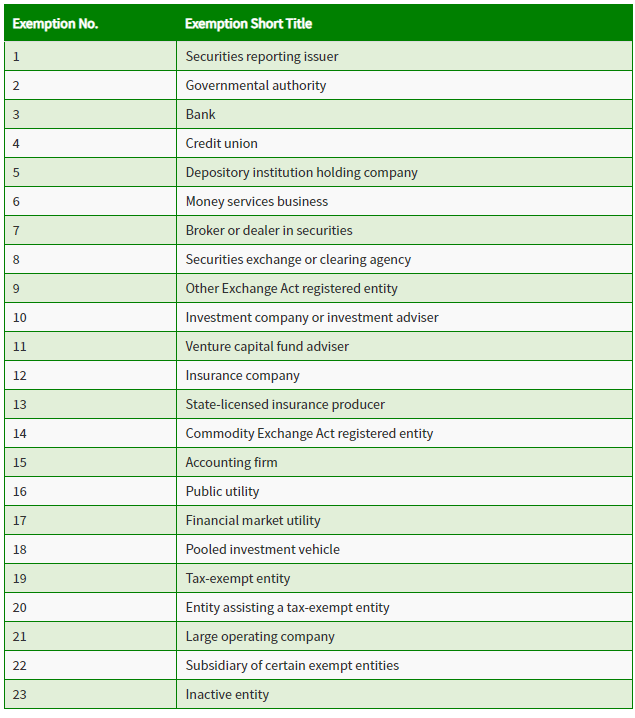
23 types of entities are excepted from BOI filing: List
Entities formed before January 1, 2024, must file these reports by January 1, 2025. Entities formed in 2024 have 90 days from formation/registration to file, while those formed after 2024 must file within 30 days.
Any changes in the reported information, such as changes in a beneficial owner’s address or name, a new passport number, or an updated driver’s license, must be reported within 30 days to avoid penalties. It is crucial to discuss who qualifies as a beneficial owner in your business and establish systems to keep this information current. Please contact our office soon to schedule an appointment for further discussion.
Florida is known as one of the lowest-taxed states in the country in part because there is no state income tax. The state government largely funds its operations through fees, sales taxes and revenue from the federal government revenue from the federal government
While Florida does not tax personal income, it’s important to note that the state does place a levy on corporate profits. So if you own a company doing business in Florida, you may owe money to the state government.
Local governments in Florida also depend on property taxes for revenue. So even though there is no statewide property tax, you’ll want to consider these municipal costs when calculating the tax burden you’ll face in Florida.
A Florida resident’s primary residence is protected from levy and execution by their judgment creditors by Article X Section 4 of the Florida Constitution. Florida also provides its residents with statutory creditor protection for life insurance proceeds and cash value, annuities, retirement accounts, and wages. This helps foster peace of mind that certain of your assets are not as easily reached by creditors. For married couples, Florida recognizes the Tenancy by the Entireties (TBE) form of joint survivorship ownership over real and personal property. TBE property may be protected from the creditors of one spouse if the other spouse is not also a party to the underlying claim.
Obviously, if you spend more than half your time in Florida, you won’t reach the 183-day threshold in the state where you spend your summers. If you can’t spend that much time in Florida, then take a vacation, visit family or friends, or otherwise spend time in some other location — anything to avoid spending 183 days or more in your high-tax summer state.